
The Blind Spot
Technology delivers the greatest value when it supports well-designed business processes. Optimising and simplifying processes before investing in automation or AI leads to greater efficiency, lower costs, and better business outcomes.
FEATURED INSIGHT
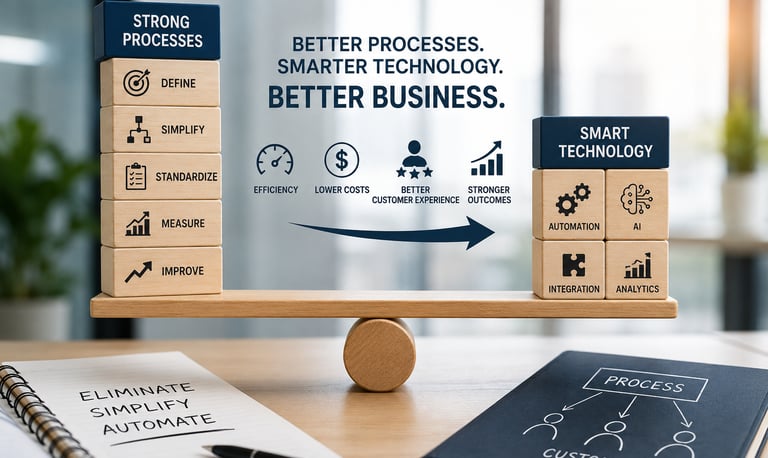
Strip any business back to its foundations and what is left is processes. A few run independently, but most depend on each other. Revenue is not really a thing you do, it is an outcome made of interdependent processes spanning marketing, sales, operations and finance. Similarly, costs are the sum of what all those processes consume as they run. And customer experience, in the end, is simply what your processes feel like from the outside.
Which raises an awkward question. If the business is made of processes, why does process optimisation get a fraction of the attention, budget and executive interest that technology does?
The irony is that we usually buy the technology for the sake of the process. Businesses don't purchase an ERP, an automation platform or an AI tool to have more software. They buy it to make a process faster, cheaper, more accurate or less painful. The process is the reason the cheque gets signed and yet often, businesses commit to the tool before we have properly understood the very thing it is meant to improve, which is a little like buying a faster car to shorten the commute when the real problem was the route you have been taking. If the technology exists to serve the process, then the process is where the work has to start.
I notice it in almost every client conversation we walk into. The airtime is on platform selections, AI initiatives and system upgrades and only rarely is it on how work actually flows between functions.
I've spent a fair bit of time contemplating why that is and the reasons are predictable once you look at them even if none of them are good ones.
1. Technology is buyable, and process is not
A platform is a product with a price, a vendor, a demo, a contract and a go-live date, so you can procure it, announce it and point at it afterwards. A process improvement is a much quieter thing. There is nothing to sign, no account team taking you to lunch to sell it, and no launch event to put in the calendar.
That asymmetry quietly shapes everything because the corporate machinery is built for purchases rather than for improvement. Procurement is designed to compare artefacts so the buyable things get bought, and capex frameworks are designed for assets, so capital gets approved. Process work fits none of those templates, and so it waits.
2. Most process problems have no owner
Almost every process worth improving crosses functional boundaries. Order to cash runs through sales, operations and finance, and procure to pay touches nearly everyone. Yet we manage organisations vertically by function, which means the end to end process is the one thing on the org chart that nobody actually owns.
What we see again and again is each function optimising its own patch without much thought for what happens upstream or downstream of it. That is how you end up with the clumsy handoffs, the rework loops, and the same data being keyed in three times because two systems will not talk to each other.
Nobody sees the whole flow horizontally across the business, so nobody is accountable for it and it degrades quietly for years until someone proposes fixing it with a platform.
Which brings me to the third reason.
3. Process improvement is invisible, and purchases are announceable
There is a career dimension to this that nobody quite says out loud. Sponsoring a major platform is legible and looks great on a CV. Taking forty per cent out of the cycle time of a core process is the opposite. The work is unglamorous, the credit is diffuse, and the result is an absence in fewer errors, fewer handoffs, and fewer customers ringing to ask where their order has got to. Absences are hard to point at in a performance review.
The expensive consequence of leading with tech before process
Let me describe what a technology first approach actually looks like when the foundational work has been skipped, because I have watched it happen more than once.
The new platform arrives, and the old process gets rebuilt inside it with every exception, workaround and redundant approval carried across intact. The mess now runs faster and costs a great deal more to change, because it lives in system configuration rather than in habit and every future tweak carries an IT change request with it. You have not fixed the blind spot, you have only digitised it, and you have done it while spending money whose entire justification was making the process better, which is the quiet tragedy of it: the tool was bought to improve the process, and instead it has set the unimproved process in concrete.
The sequence that actually works is the boring one, and I make no apology for how unglamorous it sounds.
Eliminate, then simplify, then automate.
Kill the work that should never have existed, simplify what genuinely needs to remain, and automate the work that should be invisible to a human. Do it in that order and the technology finally has something worth accelerating.
Process design is a craft, not a clean-up
Here is the part that tends to get lost. Process design is a genuine discipline, with its own methods for mapping how work really flows, for telling a value-adding step from a wasteful one, for redesigning around the customer rather than the org chart, and for building the measures that keep the new way from decaying back into the old.
Process capability is not a nice to have sitting alongside your technology strategy. It is the thing that decides whether your technology strategy delivers anything at all.
Where to start
Start with a single process, ideally one that matters (Order to cash is usually a goldmine). Walk it end to end in person, following one real transaction from the moment it starts to the moment it finishes and as you go, keep count of the handoffs between people and teams, the systems the work passes through, and the number of times a human re-keys data that a system already holds. At every step, ask "what would happen if this step simply did not exist?"
Most executives who do this once come away genuinely shocked, and honestly that shock is worth more than any business case I could write for them.
The business is the processes. Everything else, the platforms included, is only ever enablement.
We have recently developed a self process excellence self diagnostic that takes 5 minutes and provides you with a read of your process maturity. If the honest finding is you only need a few tweaks rather than an uplift, the diagnostic will say exactly that. Take it here.
We have are also kicking off our FY27 BPM Foundations course for businesses who want to build the capability inside their team. Details are here.